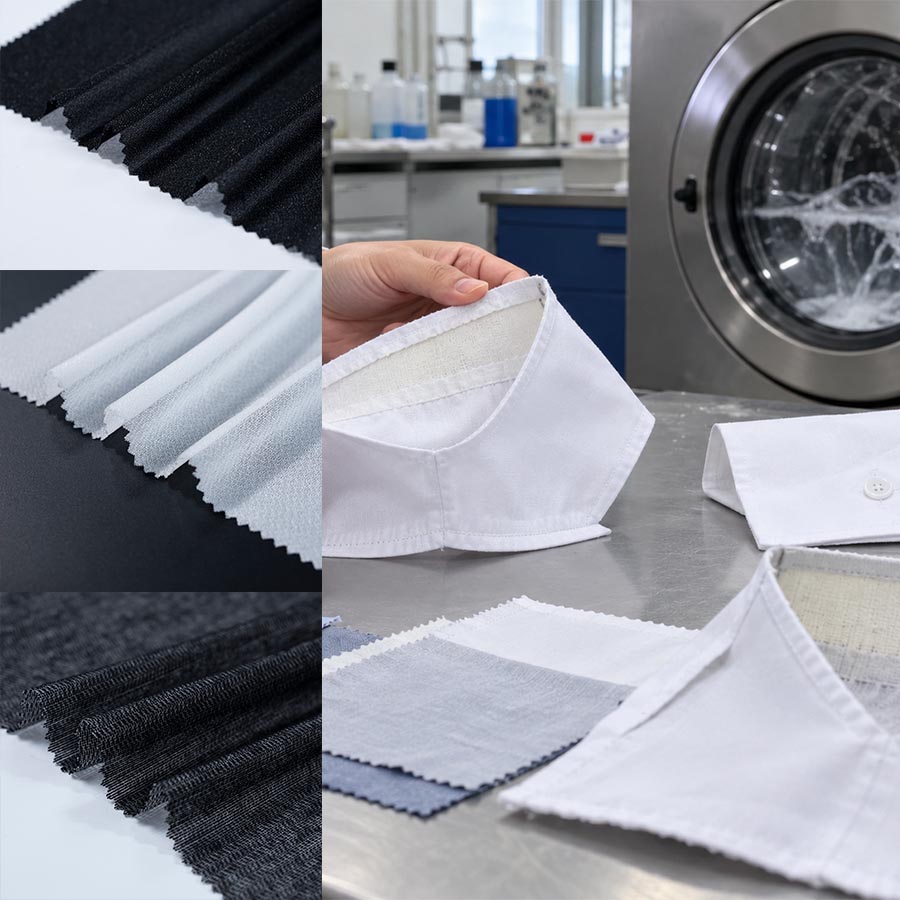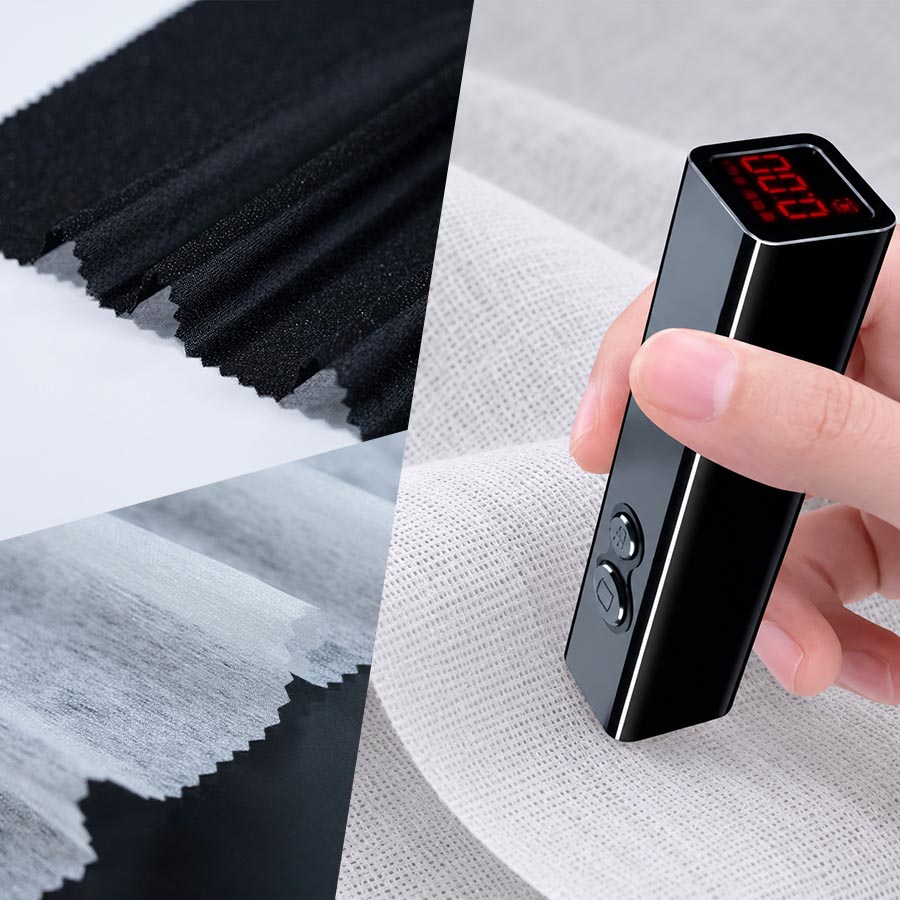
How Is Breaking Strength Tested for Interlining?
Two interlinings can have the same GSM and similar appearance but very different strength.
One may remain stable during cutting, fusing, and sewing. Another may stretch too easily or break under much lower force.
This is why interlining breaking strength is an important physical test, especially when buyers need consistent quality from sample to bulk production.
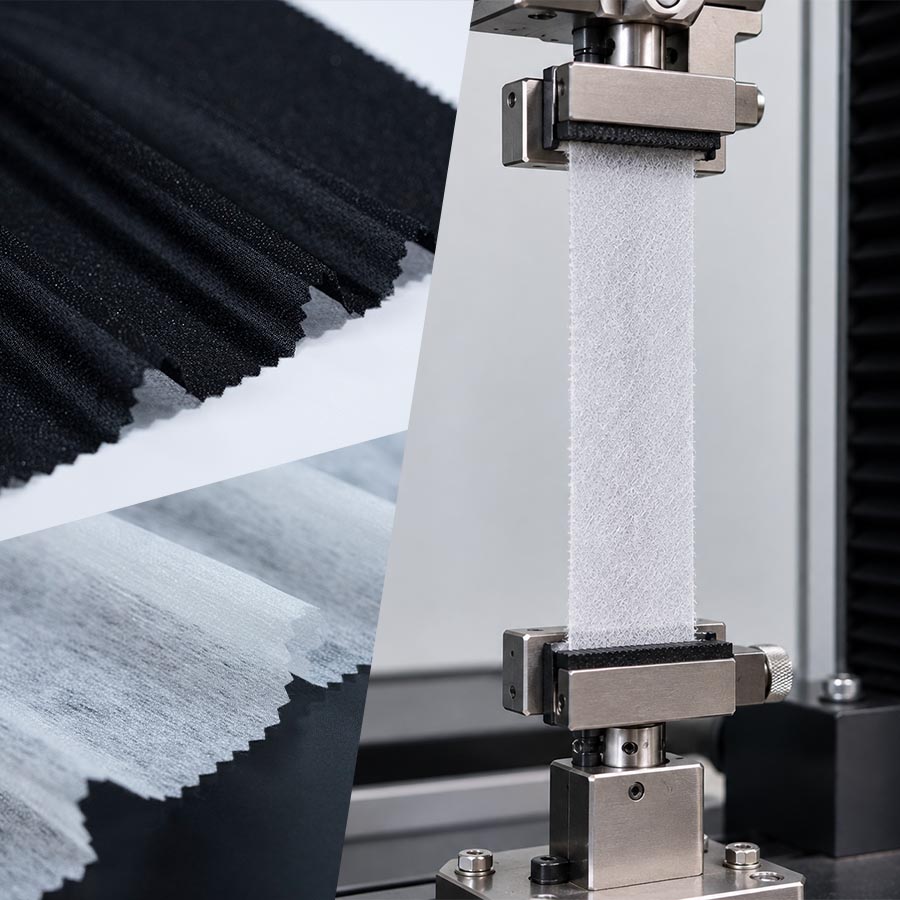
The test is usually carried out with a tensile testing machine. A prepared strip of interlining is clamped at both ends and pulled until it reaches its maximum force or breaks.
The result helps show how the material behaves when force is applied.
What Does Breaking Strength Mean?
The result is commonly reported in newtons (N).
You may also see terms such as:
breaking force, tensile strength, maximum force, and tensile test
used in specifications or test reports.
These terms are related, but they are not always technically identical. When comparing reports from different suppliers, buyers should confirm which test standard and method were used.
A number alone is not enough.
For example, a result of 300 N cannot be compared fairly with another result unless the specimen width, testing direction, test method, and conditions are similar.
Why Test Interlining Breaking Strength?
Interlining is normally hidden inside the garment, but it still goes through several mechanical processes.
During production it may be:
- Unwound from rolls
- Spread and cut
- Fused
- Sewn
- Stretched during handling
- Washed or dry cleaned with the garment
If the material is too weak, it may become distorted or damaged during processing.
Breaking strength testing is therefore useful for checking both product performance and batch consistency.
It is particularly useful when approving a new supplier, developing a customized specification, or comparing sample and bulk production.
How Is the Test Performed?
The exact procedure depends on the interlining construction and test standard, but the basic process is similar.
1. Select the Test Method
The first step is to identify whether the interlining is woven, nonwoven, or elastic.
Common methods include:
| Interlining Construction | Common Test Reference |
|---|---|
| Woven interlining | ISO 13934-1 or ASTM D5035 |
| Nonwoven interlining | ISO 9073-3 or ASTM D5035 cut strip |
| Knit / high-stretch interlining | Method selected according to construction and customer standard |
If a buyer has its own brand standard, that requirement should be followed instead.
2. Prepare the Test Specimens
Several specimens are cut from the material.
For woven fabrics, tests are normally carried out in both main fabric directions.
For nonwoven interlining, this normally means:
Machine Direction (MD) and Cross Direction (CD).
Strength can be quite different between these two directions, especially in nonwoven materials.
Samples should not all be cut from exactly the same position or from damaged areas of the roll.
3. Condition the Samples
Before testing, specimens are conditioned according to the required testing standard.
Humidity and temperature can affect textile materials, so conditioning helps make test results more comparable.
4. Clamp the Specimen
The sample is placed between the upper and lower grips of a tensile testing machine.
It should be held firmly without slipping or being damaged by the clamps.
The starting distance between the grips and the specimen size are set according to the selected standard.
5. Pull the Sample
The machine separates the grips at a controlled rate.
As the specimen stretches, the equipment continuously measures the force.
The test continues until the required endpoint is reached.
The machine records the maximum force and, when required, the elongation of the specimen.
6. Compare Several Results
One specimen should not represent the whole production batch.
Several samples are normally tested and the results are compared or averaged according to the test method.
Large differences between specimens may indicate uneven material formation or production inconsistency.
Why Are MD and CD Results Different?
This is especially important for nonwoven interlining.
During nonwoven production, fibers may be distributed more strongly in the machine direction. The structure can therefore have different tensile properties in MD and CD.
For woven interlining, warp and weft construction can also produce different strength results.
This does not automatically mean the fabric has a quality problem.
What matters is whether both directions meet the specification required for the garment application.
Breaking Strength Is Not Tear Strength
These two tests are easy to confuse.
Breaking strength measures the force needed to pull a specimen until it reaches its maximum force or breaks.
Tear strength measures how a material resists the growth of an existing cut or tear.
An interlining can perform well in one test and differently in the other.
If a customer has both requirements, both tests should be specified separately.
What Can Affect Interlining Breaking Strength?
Several factors influence the result.
The most important include fiber material, GSM, fabric construction, fiber orientation, yarn structure, bonding method, binder amount, finishing, and production conditions.
For nonwoven interlining, fiber bonding has a particularly strong influence.
For woven products, yarn strength and fabric construction are important.
This is another reason why GSM alone cannot be used to judge quality.
How Should Buyers Read a Test Report?
When comparing breaking strength results, check more than the final number.
The report should make clear the test standard, specimen direction, result unit, and whether the sample was tested dry, wet, or after another treatment.
If two suppliers use different methods, their numbers may not be directly comparable.
For purchasing decisions, it is better to define one method and use it for sample approval and future bulk inspection.
FAQ
Is higher breaking strength always better?
No. The required strength should match the garment application. Very high strength does not automatically mean the interlining has better hand feel, bonding, or garment performance.
Should woven interlining be tested in two directions?
Yes. Warp and weft directions may have different strength values.
Should nonwoven interlining be tested in MD and CD?
Yes. MD and CD results are useful because fiber orientation can create different strength levels.
Is breaking strength the same as peel strength?
No. Breaking strength measures the strength of the interlining itself. Peel strength evaluates the bond between fusible interlining and another fabric.
Can breaking strength be tested after washing?
Yes. When required, physical properties can also be evaluated after washing or other care treatments to see how the material changes.
Why Choose UNT?
With 15 years of interlining experience, UNT can provide breaking strength testing for woven, nonwoven,and other interlining products.
Our woven and nonwoven production and finishing processes allow us to control key points such as GSM, width, fabric structure, bonding, and batch consistency.
Testing can include breaking strength, tensile strength, elongation, peel strength, shrinkage, dimensional stability, fluorescence, and fusing performance.
Samples are normally available within 3 days, stock orders in 3–7 days, and customized orders in 7–15 days.
Contact Us
Shanghai Uneed Textile Co., Ltd
TEL: +86-21-33608891
FAX: +86-21-33608892
Email: info@uneed-tex.com
continue reading
Related Posts

Interlining wash test checks bonding, shrinkage, bubbling, and shape after washing. Learn what buyers should inspect before production.
-
Interlining breaking strength testing measures the force needed to break a sample and helps buyers check fabric quality and consistency.
-
Fluorescence testing for interlining checks fluorescent whitening agents and helps buyers meet garment quality requirements.