What Should You Check in an Interlining Wash Test?
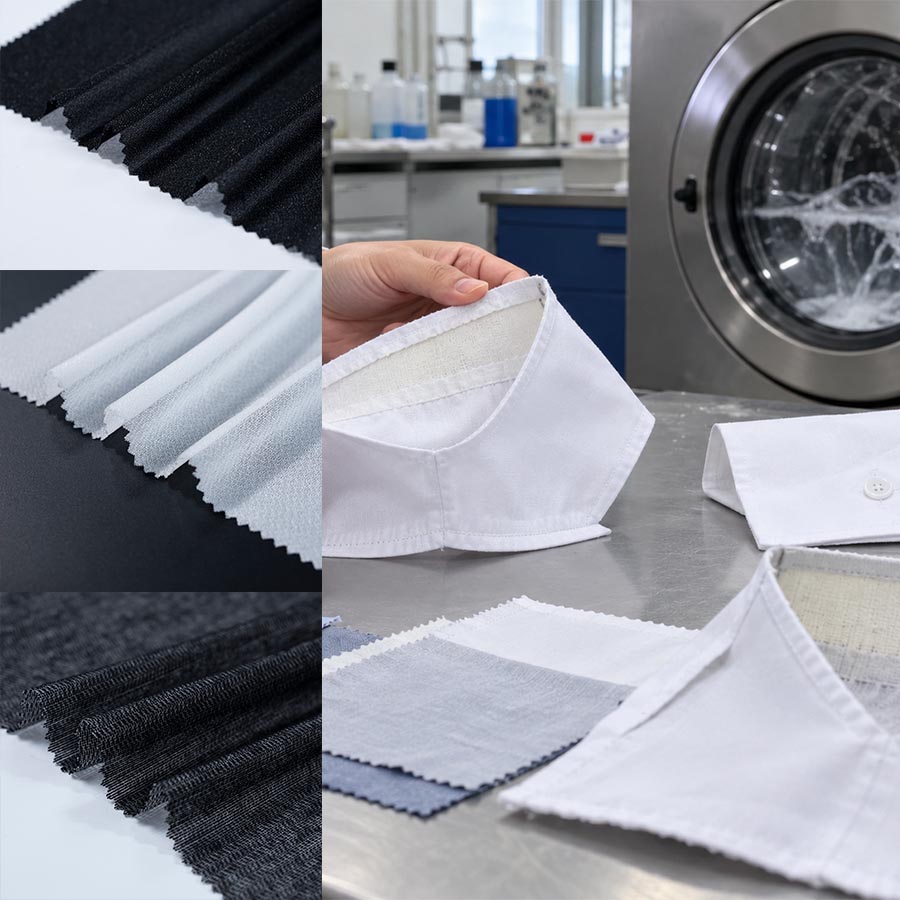
A fusible interlining may look fine immediately after pressing. The fabric feels right, the surface is smooth, and the bonding appears strong.
But after washing, the result can change.
Bubbles may appear, the edges may lift, or the garment may lose its original shape. Sometimes the interlining shrinks differently from the outer fabric, causing wrinkles that are difficult to remove.
This is why an interlining wash test is important before bulk garment production.
The test is not only about whether the interlining survives washing. It checks whether the interlining and outer fabric can continue working together after laundering.
Why Is an Interlining Wash Test Necessary?
Most fusible interlinings are bonded to another fabric using heat and pressure.
The finished material contains two layers with different physical properties. Washing introduces water, detergent, movement, and sometimes heat.
These conditions may affect the adhesive or cause the two layers to change size differently.
An interlining that performs well on one fabric may not work equally well on another.
For garment manufacturers, washing the actual bonded fabric is therefore more useful than washing the interlining alone.
What Should You Check After Washing?
Several points should be evaluated. The most important ones are listed below.
| Test Item | What to Check | Possible Problem |
|---|---|---|
| Peel strength | Bonding between the interlining and shell fabric | Separation or weak adhesion |
| Shrinkage | Dimensional changes in length and width | Wrinkles or distortion |
| Surface appearance | Smoothness of the bonded fabric | Bubbling or puckering |
| Edge bonding | Adhesion around cut edges and corners | Edge lifting |
| Hand feel | Changes in softness and stiffness | Fabric becomes too hard or loose |
| Shape retention | Stability of collars, cuffs, and garment panels | Loss of garment shape |
These checks should be compared with an unwashed reference sample.
1. Peel Strength
Peel strength is one of the main concerns for fusible interlining.
After washing and drying, check whether the adhesive still holds the two layers together.
A sample may have good initial bonding but lose strength after repeated washing.
When required, peel strength can be measured before and after laundering using an agreed test method.
2. Shrinkage and Dimensional Stability
The interlining and shell fabric may shrink at different rates.
Even when both materials show only a small amount of shrinkage, the difference can affect the finished garment.
For example, if the interlining shrinks more than the outer fabric, the surface may wrinkle or pucker.
Both lengthwise and widthwise dimensional changes should be checked.
3. Bubbling and Surface Appearance
Bubbling is one of the easiest problems to notice after washing.
It may result from weakened bonding, shrinkage differences, or unsuitable fusing conditions.
Check the entire surface, especially large bonded areas such as jacket fronts.
The fabric should also be inspected for puckering, curling, and unwanted changes in texture.
4. Edge Lifting
Some samples remain bonded in the middle but begin separating around the edges.
This is important for collars, cuffs, plackets, and small garment parts.
Inspect the edges after the sample has been washed, dried, and conditioned.
5. Hand Feel and Shape Retention
A garment may pass a bonding test but still feel different after washing.
Check whether the material becomes harder, softer, or less stable.
For shirt collars and structured garment parts, the final shape matters as much as bonding strength.
How Do You Perform an Interlining Wash Test?
The procedure should follow the customer’s care requirements or specified testing standard.
A practical evaluation usually includes five steps.
Step 1: Prepare bonded samples.
Fuse the interlining to the actual garment fabric using the approved temperature, pressure, and time.
Step 2: Record the initial condition.
Measure dimensions and check the surface, hand feel, and bonding performance before washing.
Step 3: Wash and dry the samples.
Use the agreed washing temperature, detergent, cycle, and drying method. The number of wash cycles should also be specified.
Step 4: Inspect after washing.
Allow the samples to dry and condition as required by the test method. Check for shrinkage, bubbling, separation, and appearance changes.
Step 5: Compare the results.
Compare washed and unwashed samples against the buyer’s acceptance criteria.
Testing several samples is more reliable than judging a single piece.
Which Testing Standards Are Commonly Used?
Two ISO standards are particularly relevant.
ISO 6330:2021 specifies domestic washing and drying procedures for textile testing. It provides controlled washing conditions rather than a universal pass-or-fail limit.
ISO 5077:2007 covers the determination of dimensional change after specified washing and drying procedures.
These standards can support wash-related evaluations, but separate methods and acceptance criteria may be needed for peel strength and appearance.
Buyers should confirm the testing method, number of cycles, and required result before sample approval.
What Causes Interlining Wash Test Failures?
A failed test does not always mean the interlining itself is defective.
Possible causes include:
- An adhesive unsuitable for the washing conditions
- Incorrect fusing temperature or pressure
- Insufficient bonding time
- Different shrinkage between the two fabrics
- An unsuitable interlining construction
- Fabric finishing that affects adhesion
Before changing the interlining specification, the supplier and garment factory should review the full material and fusing combination.
FAQ
How many wash cycles should interlining be tested for?
There is no single number suitable for every product. The buyer should specify the number of cycles according to the garment’s care requirements and quality standard.
Can nonwoven interlining pass a wash test?
Yes. Suitable nonwoven interlinings can perform well after washing, depending on the fiber bonding, adhesive, and washing conditions.
Is peel strength testing necessary after washing?
It is particularly useful for fusible interlining because washing can affect adhesive bonding.
Should sew-in interlining be wash tested?
Yes, when the garment is washable. However, the focus is mainly on shrinkage, appearance, strength, and dimensional stability.
Can dry-cleaning tests replace washing tests?
Not automatically. Dry cleaning and water washing use different processes. Testing should match the garment care label.
Why Choose UNT?
Shanghai Uneed Textile Co., Ltd. supplies woven, nonwoven, and knit interlining for different garment applications.
Our production supports base fabric finishing, adhesive dot coating, curing, slitting, and roll inspection, with customized GSM, widths, materials, and coating patterns.
Testing is available for wash durability, peel strength, shrinkage, dimensional stability, bonding strength, and fusing performance. OEM and ODM services are supported.
- Sampling: normally within 3 days
- Stock delivery: 3–7 days
- Customized orders: 7–15 days
- OEKO: SH001 285226
- GRS: BVC-TE-00011147-GRS-2602-50007497-V1.0
Certificate applicability depends on the specific product.
Contact Us
Shanghai Uneed Textile Co., Ltd
TEL: +86-21-33608891
FAX: +86-21-33608892
Email: info@uneed-tex.com
continue reading
Related Posts

Bag interfacing supports handbags, backpacks, totes, and travel bags. Learn how to match woven, nonwoven, and felt materials.
-
Interlining wash test checks bonding, shrinkage, bubbling, and shape after washing. Learn what buyers should inspect before production.
-
Interlining breaking strength testing measures the force needed to break a sample and helps buyers check fabric quality and consistency.