What Type of Bag Interfacing Should You Use?
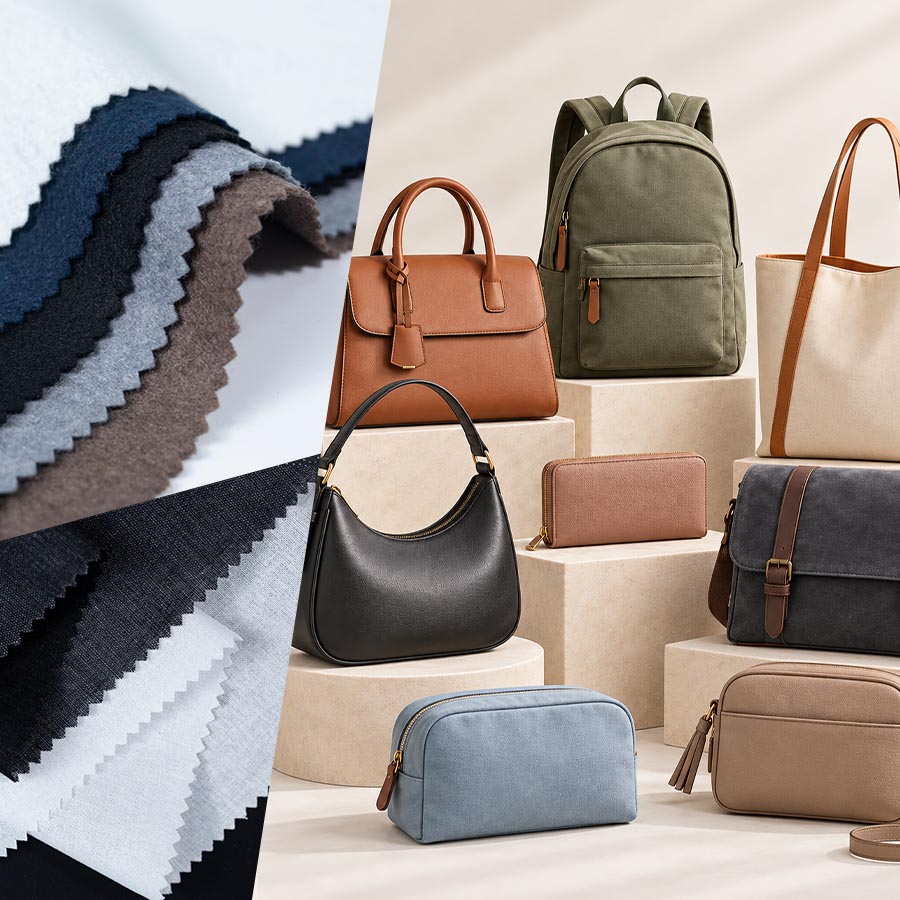
A shopping bag doesn’t need the same support as a backpack or handbag.
Shopping bags often need reinforcement around the handles. Backpacks need stronger panels and compartments. Structured handbags need firm support to keep their shape.
Using the same bag interfacing for every design can cause problems. Some bags end up too soft, while others become too stiff or difficult to sew.
To find the right material, start with the outer fabric, bag construction, thickness, and how firm you want the finished bag to be.
What Is Bag Interfacing?
Bag interfacing is a material added inside a bag to strengthen the outer fabric and help certain parts hold their shape.
It usually sits between the outer fabric and lining.
You’ll find it in:
- Front and back panels
- Side panels and gussets
- Handles and straps
- Zipper areas
- Pocket openings
- Bag flaps
- Internal compartments
Some types have heat-activated adhesive on one side. Others are sewn into the bag.
Both methods work, but they are used for different materials and bag designs.
Which Materials Are Used for Bag Interfacing?
Nonwoven Interfacing
Nonwoven interfacing is widely used for fabric bags and handbags.
It comes in different weights, thicknesses, and stiffness levels. Two common options are chemical bond and thermal bond nonwoven interfacing.
Chemical bond products are available with a softer hand feel. Thermal bond products offer different levels of firmness and stability.
For bag production, don’t look at GSM alone. Thickness and stiffness also matter, especially for panels that need to stand upright.
Woven Interfacing
Woven interfacing works well with cotton canvas and other woven bag fabrics.
It adds support without making the material completely rigid.
Fusible woven interfacing is used in fabric bags, linings, and reinforced areas.
Before ordering, fuse a sample to the actual outer fabric. This will show whether the adhesive bonds properly and whether the finished material feels right.
Needle-Punched Felt
Needle-punched felt adds thickness and body to bag panels.
It is used in backpacks, travel bags, protective layers, and other reinforced sections.
Its thickness and density make a difference. Some grades are soft and flexible, while denser grades provide firmer support.
For bags that need a very rigid structure, felt alone is not always enough.
Hot Melt Adhesive Web
Hot melt adhesive web joins two layers together.
For example, it can bond an outer fabric to another support material.
It works as an adhesive layer, not as a replacement for firm bag interfacing.
What Interfacing Is Suitable for Different Bags?
Different bags need different levels of support. The table below gives a starting point when choosing materials.
| Bag Type or Part | Recommended Material Options | Main Requirement |
|---|---|---|
| Shopping bags and totes | Woven or nonwoven interfacing | Light to medium support |
| Handbags | Firm nonwoven or woven interfacing | Panel shape and stiffness |
| Backpacks | Dense nonwoven or needle-punched felt | Panel reinforcement |
| Travel bags | Nonwoven or felt support | Thickness and shape |
| Wallets and small pouches | Thin woven or nonwoven interfacing | Support without excessive bulk |
| Handles and straps | Firm woven or nonwoven | Reinforcement |
| Rigid luggage panels | Structural stiffener or composite support | High stiffness |
Ordinary textile interfacing is often too soft for rigid suitcase shells or hard bag bottoms. These parts usually need plastic boards, stiffener sheets, or other structural materials.
What Matters When Choosing Interfacing for Bag Production?
Outer Material
Cotton canvas, polyester, nylon, PU synthetic leather, and genuine leather all behave differently during bonding.
An interfacing that bonds well to cotton won’t necessarily give the same result on PU-coated fabric.
Heat is another concern. Some coated fabrics and leather surfaces can be damaged during pressing.
For these materials, test the bonding first or consider sew-in support.
Stiffness and Thickness
First, decide how firm the finished bag needs to be.
Then compare the interfacing samples.
Don’t choose by GSM alone. Two materials with the same weight can feel quite different.
Fiber composition, fabric density, bonding method, and finishing all affect stiffness.
For structured bags, thickness and bending stiffness often tell you more than GSM.
Fusible or Sew-In
Fusible interfacing saves sewing steps because it bonds directly to the outer fabric under heat and pressure.
It works well when the bag material can handle the fusing conditions.
Sew-in interfacing is useful for heat-sensitive materials or bags that don’t need full-surface bonding.
For PU-coated fabric and leather, always test a small piece before choosing a fusible product.
Bending and Recovery
Some bags need panels that spring back after bending. Others need firm support and are not designed to bend much.
If you’re searching for “interfacing for bag” production, pay attention to what happens after the material is bent several times.
Does it return to its original shape, or does a permanent crease remain?
A small sample can feel right in your hand but behave differently once it becomes part of a sewn bag panel.
What Should Be Tested Before Bulk Production?
For bag interfacing, these tests give buyers a better understanding of the material:
- GSM and thickness: Compare the bulk material with the approved sample.
- Tensile and breaking strength: Measure how much pulling force the material can withstand.
- Tear strength: Check how easily a tear spreads through the material.
- Bending stiffness: Measure how firmly the material resists bending.
- Shape recovery: See how well it returns to shape after repeated bending.
- Peel strength: Check the bond between the interfacing and outer fabric for fusible products.
- Dimensional stability: Measure size changes after heat treatment or other processing.
For handbag interfacing and other structured bag materials, it is better to test the interfacing together with the actual outer material.
This gives a clearer idea of the finished panel’s stiffness, surface appearance, and bonding.
Common Problems with Bag Interfacing
The Bag Does Not Hold Its Shape
Start by checking the stiffness and thickness of the interfacing.
If the panels collapse easily, try a denser material or add another support layer.
The Bag Feels Too Hard
Compare the stiffness of the material and the number of support layers used.
Too much reinforcement can make the bag hard to bend, turn, or sew.
The Outer Material Wrinkles After Bonding
Check the adhesive, fusing temperature, and pressure first.
Also compare how the outer material and interfacing react to heat. Uneven shrinkage can leave wrinkles on the surface.
The Bag Panels Develop Permanent Creases
Some stiff materials don’t recover well after folding.
Try bending the sample several times before approving it for production.
FAQ
Is bag interfacing the same as handbag interfacing?
The two names often refer to similar support materials. Handbag interfacing is used specifically for handbags, while bag interfacing also covers backpacks, travel bags, totes, pouches, and other bags.
Can garment interfacing be used for bags?
Yes. Woven and nonwoven garment interlinings can also work for bags. The material needs enough stiffness, thickness, and strength for the bag design.
Is nonwoven interfacing suitable for backpacks?
Yes. Dense nonwoven materials are used to reinforce backpack panels and compartments. Choose the weight and stiffness according to the required support.
Is heavier bag interfacing always better?
No. A heavier material can make a bag too stiff or bulky. Compare thickness, stiffness, and flexibility before choosing.
Can bag interfacing be customized?
Yes. Material, GSM, thickness, width, color, stiffness, adhesive coating, roll length, and packaging can be customized.
Why Choose UNT?
Shanghai Uneed Textile Co., Ltd. supplies woven and nonwoven interlining for garment and bag production.
Our production covers nonwoven bonding, fabric finishing, adhesive dot coating, slitting, and roll inspection. We offer OEM and ODM options for GSM, width, thickness, stiffness, color, and packaging.
Testing is available for tensile strength, tear strength, breaking strength, bending stiffness, dimensional stability, and peel strength.
- Samples: normally within 3 days
- Stock orders: 3–7 days
- Customized orders: 7–15 days
Available certificates include OEKO (SH001 285226) and GRS (BVC-TE-00011147-GRS-2602-50007497-V1.0). Certificate coverage should be confirmed for the selected product.
Contact Us
Shanghai Uneed Textile Co., Ltd
TEL: +86-21-33608891
FAX: +86-21-33608892
Email: info@uneed-tex.com
continue reading
Related Posts

Bag interfacing supports handbags, backpacks, totes, and travel bags. Learn how to match woven, nonwoven, and felt materials.
-
Interlining wash test checks bonding, shrinkage, bubbling, and shape after washing. Learn what buyers should inspect before production.
-
Interlining breaking strength testing measures the force needed to break a sample and helps buyers check fabric quality and consistency.