What Interlining Is Suitable for Denim Garments?
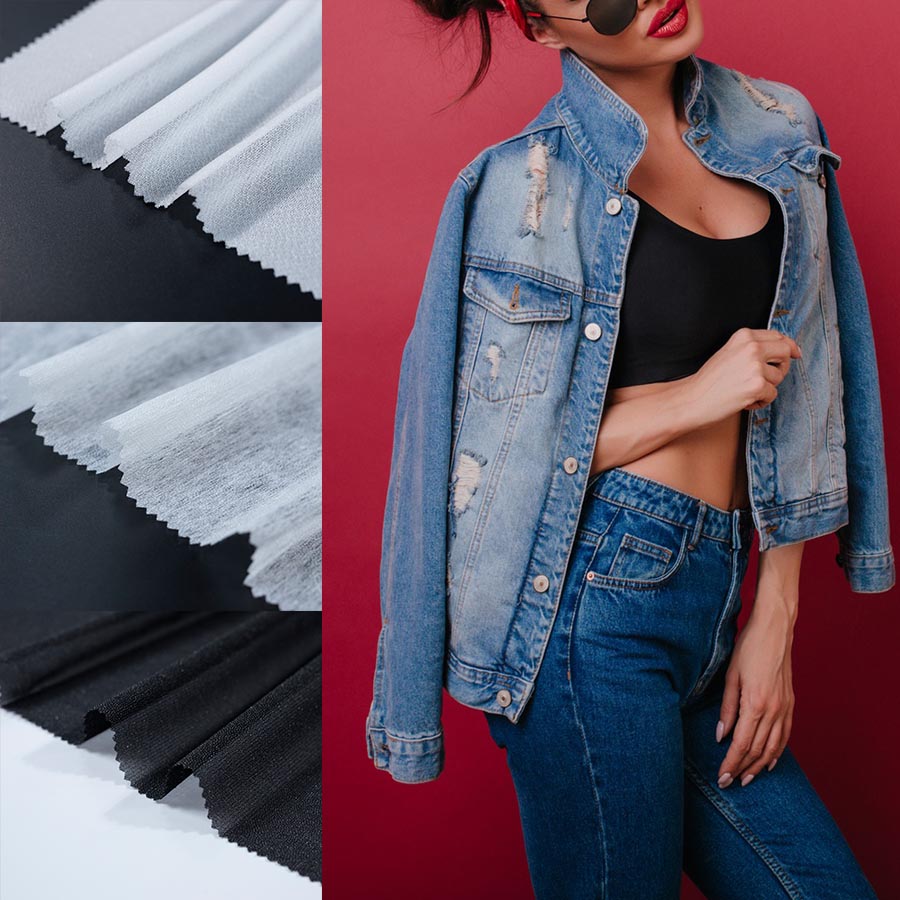
Denim jackets, jeans, and skirts don’t need interfacing in every part. Most reinforcement is used around collars, waistbands, cuffs, and front openings.
A denim jacket collar needs enough stiffness to hold its shape. A jeans waistband needs support to resist stretching during wear. Stretch denim also needs special attention because a stiff interlining can restrict the fabric’s movement.
For denim interlining, woven, nonwoven, and knit constructions are all available. The best starting point is to check the denim fabric and the part being reinforced.
Where Is Interlining Used in Denim Garments?
Denim is already a relatively strong fabric, so manufacturers usually apply interlining only where extra support is needed.
Common applications include:
- Jacket collars: Keep the collar from becoming too soft or losing shape.
- Front plackets: Support buttonholes and maintain a straight front opening.
- Cuffs: Add firmness around buttons and folded edges.
- Jeans waistbands: Reinforce the waistband and control stretching.
- Pocket flaps: Help the flap lie flat and retain its shape.
- Denim skirts: Support waistbands, front openings, and other reinforced sections.
Some garments use additional interfacing around decorative details or fastening areas.
The main purpose is to strengthen selected parts without making the finished garment too stiff.
Which Types of Interlining Work for Denim?
Woven Fusible Interlining
Woven fusible interlining is a good starting point for traditional cotton denim.
Its woven construction provides support for collars, cuffs, front plackets, and waistbands.
For a denim jacket, woven interlining helps maintain the shape of the collar and button placket. It also supports the fabric around buttonholes.
A firm woven interlining works for structured sections, while lighter grades are better for softer denim garments.
The interlining should be tested after fusing. Heavy denim does not automatically require a heavy interlining.
Nonwoven Fusible Interlining
Nonwoven fusible interlining is another option for denim garments.
It is often used in smaller reinforced areas, including pocket flaps, facings, and selected waistband sections.
Chemical bond and thermal bond nonwoven products are available in different weights and stiffness levels.
Nonwoven interlining is useful when the garment needs local reinforcement without adding too much thickness.
For parts exposed to repeated bending and washing, check the material’s strength and dimensional stability before production.
Knit Interlining
Stretch denim needs different support from rigid denim.
Many stretch denim fabrics contain elastane, allowing the garment to move with the wearer.
A firm woven or nonwoven interlining can restrict that movement.
Circular Knit Interlining is one option for stretch denim jackets, skirts, and other areas where flexibility needs to be retained.
Its knitted structure provides some stretch while supporting the fabric.
Check both stretch and recovery after fusing. The bonded fabric should still move comfortably and return toward its original shape.
For jeans waistbands, the amount of stretch needs separate consideration. Some waistband designs require firmer support to prevent the waist from growing during wear.
What Interlining Fits Different Denim Garments?
| Denim Garment or Part | Interlining to Consider | Main Requirement |
|---|---|---|
| Denim jacket collar | Woven fusible interlining | Shape and firmness |
| Jacket front placket | Woven or nonwoven interlining | Buttonhole support |
| Jacket cuffs | Woven or nonwoven interlining | Edge stability |
| Jeans waistband | Firm woven or suitable waistband interlining | Stretch control |
| Stretch denim jacket | Knit interlining | Flexibility and recovery |
| Denim skirt waistband | Woven or suitable stretch interlining | Shape and comfort |
| Pocket flaps | Lightweight woven or nonwoven | Support without bulk |
These are starting points for sampling. The final choice should be checked on the actual denim fabric.
What Should You Check When Choosing Denim Interlining?
1. Fabric Weight and Thickness
Denim fabrics range from light shirt-weight materials to heavy jeans fabrics.
For lightweight denim, thick interlining can create bulky seams and an uncomfortable hand feel.
Heavy denim already provides considerable support. In many cases, only selected sections need reinforcement.
Compare the finished bonded fabric, not just the GSM of the interlining.
2. Stretch and Recovery
Rigid denim and stretch denim behave differently.
For rigid cotton denim, woven interlining is often a suitable choice.
For stretch denim, check how much the bonded panel can stretch and whether it recovers after being pulled.
If the interlining restricts movement, try a knit construction with better stretch compatibility.
3. Fusing Performance
Denim surfaces and finishing treatments affect adhesive bonding.
Before bulk production, test the interlining with the actual denim fabric.
Check:
- Fusing temperature, pressure, and time
- Peel strength after cooling
- Surface marks or adhesive penetration
- Changes in hand feel
- Shrinkage after pressing
The fusing settings should produce a firm bond without damaging the denim surface.
4. Garment Washing
This is one of the main points to check.
Many denim garments undergo washing after sewing. Common processes include enzyme washing, stone washing, and other treatments used to change the fabric’s appearance and hand feel.
These processes expose the bonded fabric to water, movement, chemicals, and mechanical stress.
An interlining that performs well immediately after fusing can lose bonding strength after garment washing.
Before production, wash a bonded sample using the same process planned for the finished garment.
Inspect the sample for bubbling, peeling, shrinkage, and changes in stiffness.
Common Problems with Denim Interlining
The Interlining Peels After Washing
Check the adhesive and fusing conditions. Repeat the bonding test using the intended garment washing process.
The Jacket Collar Feels Too Hard
The interlining adds too much stiffness. Compare a lighter woven or nonwoven grade.
The Jeans Waistband Loses Its Shape
Check the waistband construction, interlining stability, and stretch direction. A firmer support material can help reduce unwanted stretching.
The Denim Wrinkles After Fusing
Compare shrinkage between the denim and interlining. Review the pressing temperature and pressure if the surface changes during bonding.
FAQ
Is woven interlining suitable for denim jackets?
Yes. Woven fusible interlining is commonly used to support denim jacket collars, cuffs, and front plackets.
Can nonwoven interlining be used for jeans?
Yes. Nonwoven products are used in selected reinforced areas, including some waistband constructions and small garment parts.
Which interlining works for stretch denim?
Knit interlining is a useful option for areas that need flexibility. For waistbands, the required stretch and stability should be checked separately.
Does heavy denim need heavy interlining?
Not always. Heavy denim already has body. A lighter interlining often provides enough reinforcement without adding unnecessary thickness.
Should denim interlining be tested after garment washing?
Yes. If the finished garment undergoes enzyme washing, stone washing, or another washing treatment, the bonded sample should be tested using the same process.
Can denim interlining be customized?
Yes. GSM, width, color, stiffness, fabric construction, adhesive coating, and roll specifications can be customized.
Why Choose UNT?
Shanghai Uneed Textile Co., Ltd. supplies woven, nonwoven, and knit interlining for denim garments and other clothing applications.
Our production supply covers weaving, knitting, nonwoven bonding, fabric finishing, adhesive dot coating, slitting, and roll inspection. We offer OEM and ODM options for GSM, width, stiffness, color, and coating.
Testing is available for peel strength, tensile strength, shrinkage, stretch recovery, fusing performance, and wash resistance.
- Samples: normally within 3 days
- Stock orders: 3–7 days
- Customized orders: 7–15 days
Available certificates include OEKO (SH001 285226) and GRS (BVC-TE-00011147-GRS-2602-50007497-V1.0). Certificate coverage should be confirmed for the selected product.
Contact Us
Shanghai Uneed Textile Co., Ltd.
TEL: +86-21-33608891
FAX: +86-21-33608892
Email: info@uneed-tex.com
continue reading
Related Posts
-
Denim interlining for jeans, jackets, and skirts. Compare woven, nonwoven, and knit options, plus washing and bonding tests.

Trench coat interlining for wool, cashmere, and lightweight coats. Compare napped, warp knit, and other interlining options.
-
Handbag interfacing helps soft and structured handbags hold their shape. Compare materials for panels, flaps, and handles.