Which Interlining Is Suitable for Wool Coats?
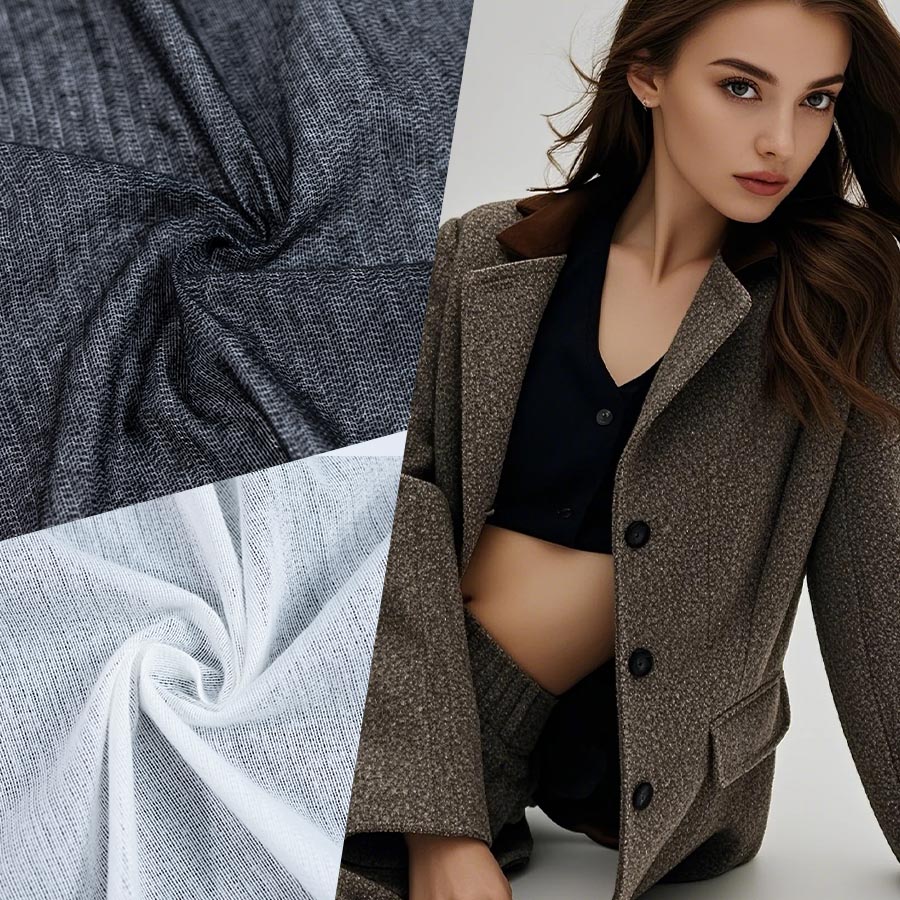
Wool coats usually need more internal support than lightweight garments, but choosing the heaviest interlining is not the answer.
A wool fabric may be thick, soft, brushed, or loosely woven. If the interlining is too firm, the coat can lose its natural drape. If it is too light, the front and collar may not hold their shape.
The right interlining for wool coats should support the garment while keeping the original character of the wool fabric.
In most cases, woven interlining, weft insert napping interlining, and hair interlining are the main options to consider.
What Should Wool Coat Interlining Do?
A coat interlining may be used in:
- Front panels
- Collars
- Lapels
- Facings
- Chest areas
- Cuffs
- Pocket openings
Different areas do not always need the same level of support.
For example, the coat front may need enough body to hang smoothly, while the lapel needs support without becoming rigid.
This is why coat manufacturers often use more than one interlining specification in the same garment.
Which Types Work Well for Wool Coats?
| Interlining Type | Main Character | Better Suited For |
|---|---|---|
| Woven Fusible Interlining | Stable, fabric-like support | General wool coats and structured fronts |
| Weft Insert Napping Interlining | Fuller and softer hand feel | Thick wool and brushed coat fabrics |
| Hair Interlining | Structured with natural movement | Tailored and higher-structure coats |
| Nonwoven Interlining | Economical and available in many weights | Selected coat parts and general production |
The best option depends on the coat fabric and construction.
Woven Fusible Interlining
Woven fusible interlining is a common choice for wool coats produced on industrial garment lines.
It can provide stable support while keeping a fabric-like structure.
For wool coat applications, buyers should pay attention to:
- Base fabric weight
- Firmness
- Adhesive coating
- Glue dot size
- Shrinkage
- Fusing temperature
A coarse or heavy adhesive coating may make a soft wool fabric feel harder after fusing.
For this reason, the combined hand feel should always be checked.
Weft Insert Napping Interlining
For thicker wool coats, weft insert napping interlining is often worth testing.
This construction has a raised or napped surface that gives the interlining a fuller and softer feel.
It can work well with heavier coat fabrics where the buyer wants support without creating a flat or board-like result.
It is especially suitable for garments with lower washing requirements, which fits many wool coats that are mainly dry cleaned.
The napped surface also helps the internal layer feel more compatible with soft or brushed outer fabrics.
Hair Interlining for Tailored Coats
For tailored wool coats, hair interlining can be used when more natural structure is required.
Unlike fully fusible products, hair interlining is generally sewn into the garment construction.
This allows the shell fabric and internal support to move more independently.
It can be used around:
- Chest areas
- Front panels
- Lapels
- Structured coat sections
Hair interlining is more common in tailored garments where shape and drape are more important than fast production.
Is Nonwoven Interlining Suitable?
Yes, but it depends on the coat.
Nonwoven interlining can be used for selected parts or for coats where cost and production efficiency are important.
However, very heavy wool fabric may need more structure than a lightweight nonwoven can provide.
The hand feel also needs attention.
A firm nonwoven product may make a soft wool coat feel unnatural, so the outer fabric should be tested before bulk production.
Why Is Fusing More Difficult with Wool Fabric?
Too much heat or pressure may:
- Flatten the surface
- Change the fabric texture
- Create shine
- Cause shrinkage
- Affect the original hand feel
Brushed or raised wool fabrics need even more care.
The interlining should therefore be tested at different temperature, pressure, and time settings before production begins.
It is better to find the lowest effective fusing condition that still gives stable bonding.
What Should Be Tested?
For wool coat production, testing should focus on both bonding and appearance.
Important checks include:
- Peel strength
- Bonding strength
- Shrinkage
- Dimensional stability
- Tensile strength
- Breaking strength
- Fusing temperature
- Pressure and time
- Surface appearance
- Hand feel after fusing
- Dry-cleaning performance
- Fluorescence
The test sample should use the actual wool fabric whenever possible.
A small difference in surface finish or thickness can change the bonding result.
Common Problems with Wool Coat Interlining
The Coat Feels Too Hard
The interlining may be too heavy or too firm, or the coating amount may be too high.
Changing the interlining construction may work better than simply reducing GSM.
The Wool Surface Becomes Flat
Fusing temperature or pressure may be too high for the fabric.
This is especially common with brushed or raised surfaces.
Bubbling Appears Later
Possible causes include weak bonding, incorrect fusing conditions, or different shrinkage between the wool fabric and interlining.
The Coat Front Has Too Little Structure
The selected interlining may be too soft for the weight of the shell fabric.
A woven, napped, or hair interlining with more body may be needed.
FAQ
Is woven interlining suitable for wool coats?
Yes. Woven fusible interlining is commonly used when stable support is required.
When should weft insert napping interlining be used?
It is useful for heavier or softer coat fabrics where fuller support and a softer hand feel are needed.
Is hair interlining suitable for wool coats?
Yes. It is especially suitable for tailored coats and garments requiring a more natural internal structure.
Should wool coat interlining be dry-cleaning tested?
Yes, if the finished garment will be dry cleaned, the combined fabric and interlining should be tested under similar conditions.
Why Choose UNT?
With 15 years of experience in interlining, UNT supplies woven, weft insert napping, nonwoven, and hair interlining for different wool coat constructions.
Our production supports different GSM, widths, colors, hand feels, adhesive coatings, and glue dot patterns. OEM and ODM are available.
Testing can include peel strength, bonding strength, shrinkage, dimensional stability, tensile and breaking strength, fusing conditions, dry-cleaning performance, and fluorescence.
- Samples: within 3 days
- Stock orders: 3–7 days
- Customized orders: 7–15 days
- OEKO: SH001 285226
- GRS: BVC-TE-00011147-GRS-2602-50007497-V1.0
Contact Us
Shanghai Uneed Textile Co., Ltd
TEL: +86-21-33608891
FAX: +86-21-33608892
Email: info@uneed-tex.com
continue reading
Related Posts

Fluorescence testing for interlining checks fluorescent whitening agents and helps buyers meet garment quality requirements.
-
Interlining for wool coats should add shape without making the fabric stiff. Compare woven, napped, and hair interlining options.
-
Microdot fusible interlinings use fine adhesive dots for smooth bonding, soft hand feel, and clean garment appearance.