
What Is Horsehair Interfacing?
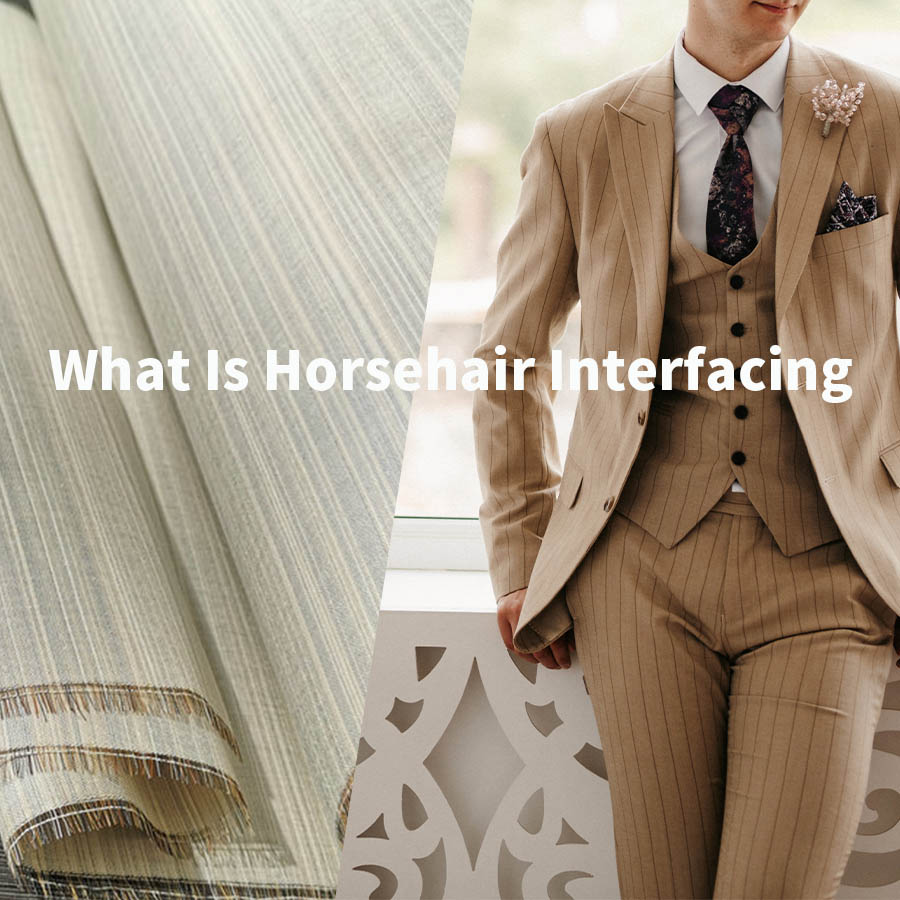
Horsehair interfacing is a structured support material used inside garments.
It is made with natural horsehair blended with other fibers such as:
- wool
- cotton
- synthetic support fibers
Its purpose is simple:
to help garments hold shape while staying flexible.
That is why it is commonly used in tailored clothing.
Why Do Buyers Specifically Search for “Horsehair”?
Usually because they already know what they want.
They are not looking for basic interfacing.
They are looking for:
- traditional tailoring materials
- natural-fiber support
- premium garment construction
That makes this a very targeted keyword.
Why Is Horsehair Still Used Today?
Synthetic materials are everywhere.
But horsehair still remains in the market for a reason.
1. Natural Recovery
Horsehair naturally springs back after bending.
That helps garments recover shape after wearing.
2. Better Tailoring Performance
Many traditional suit constructions were originally designed around materials like this.
That experience still matters.
3. Premium Positioning
When brands want to communicate “quality,” materials matter.
Horsehair is often part of that story.
Where Is Horsehair Interfacing Used?
Mainly in tailored garments.
Typical applications:
- suits
- blazers
- formal jackets
- chest construction
- lapels
Rarely used in:
- fast fashion
- basic uniforms
- casual garments
👉 Simple rule:
if the garment is premium, horsehair often becomes relevant
Horsehair Interfacing vs Standard Interfacing
This is a common sourcing comparison.
| Feature | Horsehair Interfacing | Standard Interfacing |
|---|---|---|
| Fiber Type | Natural blend | Mostly synthetic |
| Shape Recovery | High | Medium |
| Garment Feel | More natural | More fixed |
| Cost | Higher | Lower |
| Main Use | Tailoring | General apparel |
How to Choose Horsehair Interfacing
Buyers usually focus on three things.
1. Horsehair Content
Higher content usually means stronger support.
Lower content usually feels softer.
2. Garment Category
A structured coat needs something different from a soft blazer.
Choose accordingly.
3. Production Method
Most horsehair products are used in sewn constructions.
Check your factory process first.
Common Buyer Questions
1. Is horsehair the same as horse hair?
Yes. It is usually just a spelling difference.
2. Is horsehair interfacing natural?
Partly yes—horsehair is a natural fiber.
3. Is it only for suits?
Mostly, but also used in premium coats and blazers.
4. Is it expensive?
Usually more expensive than synthetic alternatives.
5. Does it improve garment quality?
Yes, especially in tailoring.
6. Is it washable?
It depends on garment construction and care method.
7. Is it sewn in?
Most commonly, yes.
8. Why do premium brands still use it?
Because it delivers long-term shape and better garment feel.
Why Choose UNT for Horsehair Interfacing?
UNT has more than 10 years of experience supplying horsehair interfacing and hair canvas for suits, blazers, coats, and other tailored garments.
Our production covers hair interlining weaving, finishing, width setting, rolling, inspection, and packing. Specifications can be adjusted according to the garment structure and required hand feel.
OEM and ODM customization can include:
- Material composition
- Fabric weight
- Width
- Color
- Firmness and hand feel
- Roll length
- Labels and packaging
For horsehair interfacing, testing can be provided for:
- Tensile strength
- Breaking strength
- Fabric weight
- Width
- Shrinkage
- Dimensional stability
- Elongation
- Stiffness and hand feel
- Shape recovery
- Fluorescence
Customers can send an existing hair canvas sample or garment requirement for matching and development.
- Samples: normally within 3 days
- Stock orders: normally 3–7 days
- Customized orders: normally 7–15 days
Available certification includes OEKO (SH001 285226) and GRS (BVC-TE-00011147-GRS-2602-50007497-V1.0), subject to the specific material and product specification.
Contact Us
Shanghai Uneed Textile Co., Ltd
TEL: +86-21-33608891
FAX: +86-21-33608892
Email: info@uneed-tex.com
continue reading
Related Posts

Fluorescence testing for interlining checks fluorescent whitening agents and helps buyers meet garment quality requirements.
-
Interlining for wool coats should add shape without making the fabric stiff. Compare woven, napped, and hair interlining options.
-
Microdot fusible interlinings use fine adhesive dots for smooth bonding, soft hand feel, and clean garment appearance.
.png)